Crop Rotation Basics for Open Fields in Poland
A structured guide to designing four-year and six-year rotation sequences on heavy loam and sandy soils, with attention to weed pressure and nutrient carry-over.
Read article
Field-level reference on rotation planning, organic matter dynamics and cover crop selection — focused on the agronomic conditions of central and northern Poland.
Articles
Three focused articles covering the core principles of sustainable rotation and soil management under Polish field conditions.
A structured guide to designing four-year and six-year rotation sequences on heavy loam and sandy soils, with attention to weed pressure and nutrient carry-over.
How organic matter levels decline under continuous cereals, and which management practices help rebuild carbon content in Polish agricultural soils over a rotation cycle.
Comparison of winter and summer cover crop mixes — phacelia, winter rye, oil radish, legume blends — and their effects on erosion control, nitrogen supply and soil biology.
Soil Structure
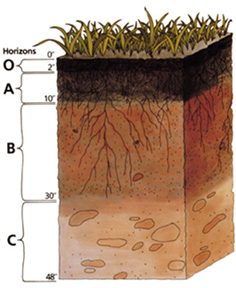
The depth and composition of the A-horizon (topsoil) directly affects which crops tolerate waterlogging, drought stress or compaction. On heavy soils in Mazowsze and Kujawy, topsoil depth typically ranges between 20 and 35 cm — shallow enough that subsoil compaction from machinery becomes a measurable yield constraint within two to three seasons.
Reading a soil profile before setting a rotation is a standard recommendation from the Institute of Soil Science and Plant Cultivation (IUNG-PIB) in Puławy, which maintains soil monitoring data across Polish administrative regions.
Key Topics
How to order crops to reduce disease carry-over, balance nitrogen demand and manage weed populations across a four-to-six-year plan.
Reading Okta and standard lab reports — pH, phosphorus, potassium, magnesium, and humus content — and translating results into practical actions.
Establishment windows for summer and winter covers in Polish climate conditions, including frost risk dates and optimal sowing rates.
How tillage intensity, crop residue management and green manures affect the humus balance over multiple years of cultivation.
Contribution of legumes — field beans, lupins, peas — to the following crop's nitrogen budget and how to account for it in fertilisation plans.
Regional soil type distribution across Masovia, Greater Poland and Warmia-Masuria, and how soil texture affects rotation flexibility.
Soil Biology
Earthworm populations correlate with soil organic matter content, tillage frequency and pesticide load. In well-managed rotations with regular organic inputs, densities of 40–80 individuals per square metre are achievable in Polish loam soils; intensive monoculture systems often show fewer than 10.
Counting earthworms during soil sampling takes under five minutes and gives a quick read on biological activity that laboratory tests alone do not capture. The method is described in FAO's "Earthworm as Bioindicators of Soil Quality" guidance document.
This form is for informational enquiries about the content on this site. No personal data is stored or transmitted to third parties.
Response time is typically two to four working days.
NorthPlain
ul. Agronoma 12
00-001 Warsaw, Poland
contact@northplain.eu
The information on this site is for general informational purposes only. Field conditions vary; consult a certified agronomist before making management decisions.